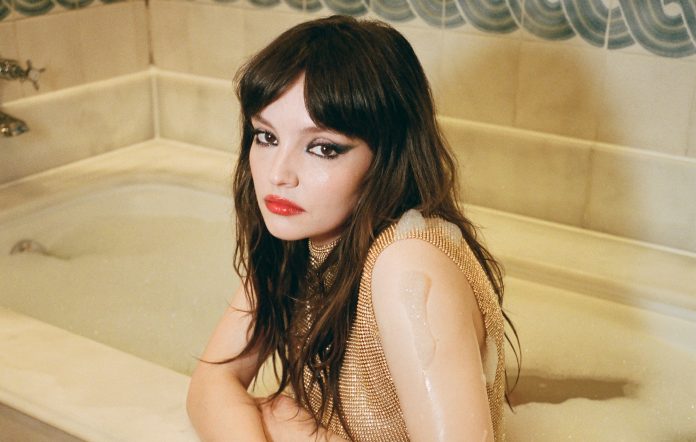
Lauren Mayberry of Chvrches has always shown depth and skill in songwriting through the richness of their music, whether conceptual or not. It’s a sticking point that keeps one reeled in, despite the production sometimes being inconsistent; unfortunately, that continues to show itself with Lauren Mayberry’s debut solo album, Vicious Creature, which, true to its title, is reflected in the approach she takes, both lyrically and melodically. In music, certain topics aren’t always broached directly because they can manipulate perception, specifically when catchy poptisms are the undercoating of its themes—in Vicious Creature, mortality, societal pressure, personal growth, and sexism in the music industry—She traverses them with virtuosity, even when production takes a step back from the more apropos cadences heard on Chvrches albums, especially the vocal effects within the choruses. Mayberry is also working with producers who are new to her—Doug McDougall, Greg Kurstin, Mathew Koma, and Ethan Gruska—they bring a blend of pop and rock into the fray without feeling too obscure. As I listened to Vicious Creatures, Lauren Mayberry stood out as a songwriter and performer, showing she’s more than the sum of her parts beyond the band.
The production of Vicious Creature is a definitive shift from the electronic, synth-heavy nature of the Chvrches albums, but that’s a given since we are listening to a different cog in that machine. Though it isn’t to say that this shift is a downgrade; instead, it feels more refreshing when there isn’t another thin veil of elevated vocals aided by synths. Synths aren’t removed; rather, they play more with the acoustics of their space and give us a more refined pop album. Lauren Mayberry notes that influences on the album include Fiona Apple, Tori Amos, PJ Harvey, Annie Lennox, Jenny Lewis, and Sinéad O’Connor, specifically their sense of wonder and zeal for its parts and sum. What these artists have in common regarding the direction taken by Lauren Mayberry is the way they write and relay their feelings and thoughts with conviction, never caring for the stigmata of certain pop archetypes. It isn’t trying to reel you in with some glitzy pop banger; instead, it allows the melodies to control the pathos of its catchiness. It opens with this uniquely rudimentary synth-pop beat akin to a classic Chvrches song, but it begins to divulge into these oft-tangled tangents, which are molded by its layers.
“Shame” is the first real flip in the tracklist, where production isn’t so heavy on atmosphere, instead amplifying the poppy textures with help from its percussion. Though it doesn’t break new ground, it brings something different to Lauren Mayberry that wasn’t a full comfort zone before; however, it lyrically remains authentically her. It leaves with a balanced hybrid that parallels the notion of shame, specifically not feeling it since what is reflected is an aspect of growth. After this, Mayberry starts to perform over production more opposite the norm, but not out of the realm with tracks that dive into more ballads or clashing pop tinges, elevating it to something new, like the bombastic “Sorry, etc,” where she laments fitting in, considering her history of being the only female in her three bands: Blue Sky Archives, Boyfriend/Girlfriend, and Chvrches. It’s an album that adds more definition to her character, allowing you to hear a wider sense of her artistry that isn’t part of a centralized genre like Chvrches. It isn’t a knock on Chvrches as I’m a relatively big fan, yet knowing that these possibilities exist makes the album feel more impactful, like when the mildly funk pop-rock “Sunday Best” comes on later in the tracklist.
Though the production is significant, what I keep returning to is the writing. Melodically, Lauren Mayberry works around some comfortable cadences and flows, giving us something more akin to who she is, with the rare ballad lamenting differently. But none of it can function without having something to strive for, and here, it’s the writing, which doesn’t try to cut corners with rhymes; instead, it speaks from her core. With “Punch Drunk,” Mayberry sings about the heightened experience of love, specifically the thrill. In “Changing Shapes,” Mayberry sings about the delineation between artist and person as if she is projecting a certain way, like the horror elements of Screen Violence—she breaks down conceptions fluidly while maintaining a sturdy bridge of connectivity. We hear that beautifully in “A Work of Fiction,” which is thematically akin to “Changing Shapes,” except different. Much of it comes with more familiarity, as some themes are relative to what she consumes more regularly, like feminist texts (as witnessed through the years following her on Instagram). It’s a definitive high that separates her from her peers and shines greatly on her debut.
It’s safe to say I was a fan of Lauren Mayberry’s solo debut. It stands strong as the music follows through with virtuosity and bravado that what she says doesn’t get lost. Unfortunately, the production isn’t as captivating and it can be hard to latch onto the two without having much behind it to bolster it. I’d give it a shot if you’re a fan, or looking for something new on the lyrical front because Mayberry brings her all at 200%.


Leave a Reply