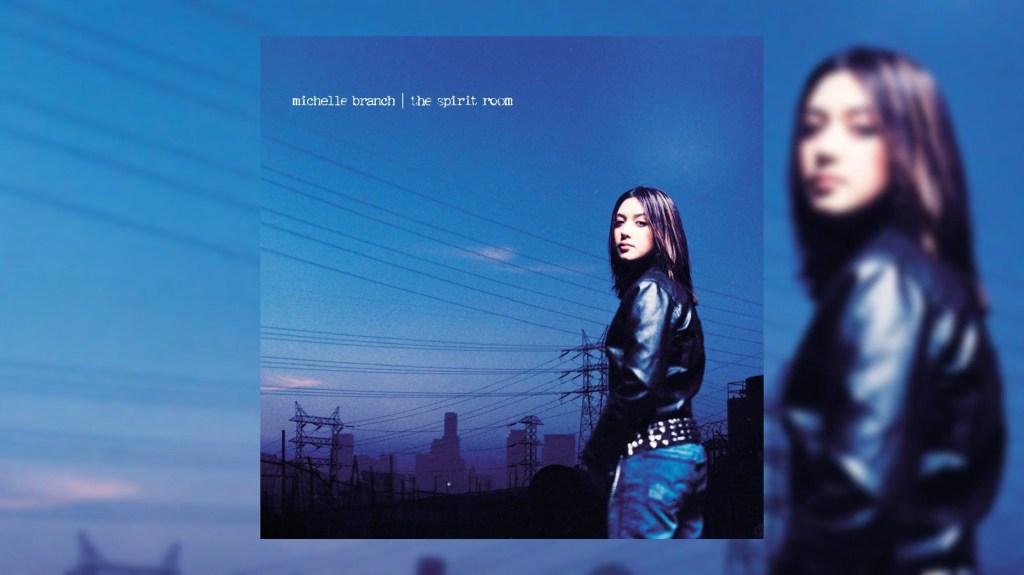
Michelle Branch’s 2001 album The Spirit Room is an all-timer for me from the late ‘90s and early 2000s. Alongside albums such as Matchbox Twenty’s Yourself or Someone Like You, Norah Jones’ Come Away With Me, and The Interstate Managers by Fountains of Wayne, it defined my musical likes outside of hip-hop. The reason The Spirit Room did so is because of Branch’s songwriting and performances, which are never overshadowed by the production. Instead, they remain at the album’s emotional core; the same for the other albums mentioned. The production on The Spirit Room helps bolster her performances, like “You Get Me” with its acoustic guitar and drums as its two core elements and supported by its bass grooves and melancholic keyboards, or the more complete four-piece “You Set Me Free,” which sounds like a perfectly confident rock anthem with how the instruments beautifully connect. That’s also why bigger hits like “Everywhere,” “Goodbye to You,” and “Sweet Misery” stand out so much. As The Spirit Room turns 25 years old, I still find myself reflecting on the balance between Branch’s songwriting, her performances, and the production—qualities that have kept the album in my rotation for over a decade.
Michelle Branch’s songwriting is the driving force behind the album and the main reason why I love The Spirit Room so much. It’s pure of heart without relying on trendy cash-grabby pop rock like P!nk’s “Get the Party Started.” That isn’t to throw shade at P!nk, as that song is actually fun, and I’d definitely bounce to it at the club, but it doesn’t have the same depth as the songs on The Spirit Room. Though you could argue that the album has some redundancy, as she often sings about relationships, she takes different angles on the subject. “If Only She Knew” questions the morality of seeing someone who is already in a relationship; “Here With Me” is about lost love, but then she can hit you with something different like “You Get Me.” This song focuses on Branch’s quirks and how she’s different from everyone else. She cuts deep and gives us a side of herself that is expanded upon in “All You Wanted,” which follows.
I love how much the production serves the songwriting rather than competing with it. It’s that complement that resonated, because Michelle Branch’s direct approach to songwriting and her collaboration with producers excelled on their own merits.
The Spirit Room is by no means a musical masterpiece compared to seminal works highly regarded by audiences and critics alike, such as Fiona Apple’s Tidal. For me, it’s a subjective masterpiece. That could be because the instrumentation isn’t trying to be something complex and particularly thought-provoking. Instead, it creates fantastic alternative rock and pop-rock compositions that never drift into the mundane. You can hear the synergy in the instrumentation, with a few surprises, like the beautiful cohesion between acoustic guitars and synthesizers on “Sweet Misery” or the free-flowing nature of “You Set Me Free.” The latter has a captivating moment where the drums isolate into a unique rhythm when Michelle Branch sings the title.
“Drop in the Ocean,” the definitive highlight, incorporates synth sequences that elevate Branch’s vocal performance, giving the acoustic echoes more gravitas. However, you can’t forget the singles “Everywhere,” “All You Wanted,” and “Goodbye to You,” which are mesmerizing anthems filled with raw emotion that power over the production triumphantly, especially “All You Wanted.” Though I’m more partial to “Goodbye to You,” “All You Wanted” encompasses all the elements that make the album one of the most memorable releases of 2001, from the instrumentation to the viscerally emotive writing. The Spirit Room is probably not the most groundbreaking album of the time, but it doesn’t need to be. All that mattered was the lasting power as a cornerstone for my musical interest. It taught me that sometimes all you need is great songwriting and production that knows when to step forward and when to get out of the way.


Leave a Reply