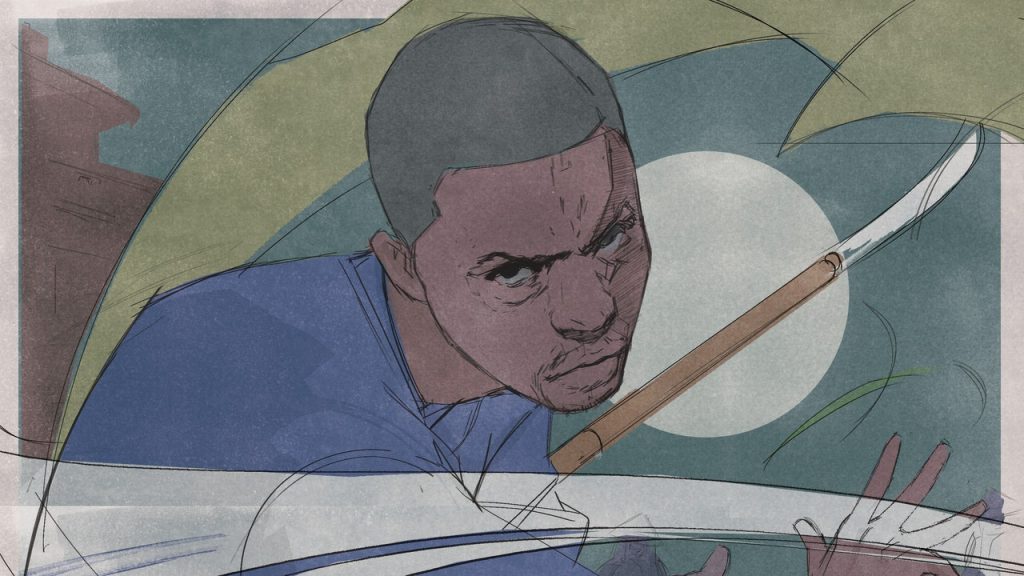
Lupe Fiasco has painted portraits as homages for years, a favorite being “Hip-Hop Saved My Life,” which was an homage to Slim Thug, one of the greatest to come out of Texas. But his work spoke more than just mesmerizing visuals painted through his words; he embodies these people without distortions, offering more emotional depth to what is getting said, and with his new album, Samurai, it’s Amy Winehouse. As Lupe would tweet before its release, “Samurai in 5…A loving & living portrait to and of one of my favorite artists, Amy Winehouse…This one took on a life of its own and became an album. Looking forward to sharing it.” As he finally shares it, we see why he was looking forward to it, considering Lupe comes with an immediate impact on the title track, making sense of the direction taken with this portrait—emanating from the chorus, Lupe becomes Amy Winehouse, post writing rap bars and talking about it to Salaam Remi, as seen in Asif Kapadia’s documentary Amy (2015); from there, he doesn’t turn back, keeping the momentum high with the connections and delivering one of his bests to date.
What’s beautiful about the eponymous track is how it pushes forward these sentiments by building up this sense of wonder we saw in Amy (2015), which personified her humanity and her own correlation to being a samurai. Taking it as a means to achieve and conquer the craft, one hears Lupe construct a conceptual story where Amy is now rapping. Continuing that story, it goes through the motions, like winning her first rap battle on “Mumble Rap,” to seeing new heights with fame, later seeing the reality, and understanding the truth in “Palaces.” Though it isn’t just that; there are so many layers to the album, especially as he hones in on the Samurai, considering part of the voicemail influencing the direction has Amy Winehouse comparing herself to such. The way topics are approached and handled, you see some of the nuances he brings from finding parallels between their artistry, which he notes from some lyrics. After a solid setup, the world becomes more open, and what Lupe gives us is nothing short of fantastic. Though he didn’t do it solo, and accompanying him in creating this craft is Soundtrakk, who produced his last album, Drill Music In Zion, which I was also high on.
Soundtrakk offers an exceptional palette of Jazz-Rap beats that exemplify that old soul nature one has said about Amy Winehouse, and it isn’t new territory for Lupe Fiasco. His driven focus gives us these memorable moments like the opening trumpet and saxophone in “Samurai,” whisking you away with the cadences of what one thinks of Jazz, and from there, we got more of a percussion-laced flow, never relying on one drum pattern or piano melody. The variance is there, and the transitions come smoothly, but what’s more important is how it all translates, especially when painting this portrait. It’s the boom-bap influence in “Mumble Rap,” the gloomy horns in “Bigfoot,” or the beautifully drum-busy “Cake,” one of the standouts on the album; it doesn’t play coy and takes the microphone like the chef grabbing his palette of knives, constantly flipping to chop up the right ingredients. It’s nuanced with its braggadocio nature, secluding the one win above others, further showcasing the happiness before the negative parallel seen in “Palaces.” Soundtrakk doesn’t produce it solo, despite the sole credit. That said, Kush Baby, Brian L. Brown, Nicolaus Isaiah, and Trumaine Jordan deserve notice for their work, mainly with the live instrumentations.
What Lupe Fiasco does with Samurai is deliver this sense of integrity and strength, realizing your world without letting yourself get consumed by the hollow surface perpetuated in front of one, as it gets expressed here and more. He hones further into that strength with “No. 1 Headband,” where that becomes a primary focus, reinforcing the character he plays, i.e., Amy, before breaking it down and more. It doesn’t shift perception but instead weaves a tapestry of parallels that revolve around her artistry and the emotional distress seen and discussed in Amy (2015). It’s original, breathtaking, and ends on a captivatingly great note with “Till Eternity.” It’s an album that tests one fortitude because of the subject and approach, but I never felt it came out as ill-advised, and makes for a much cleaner listen. It’s an album I highly recommend, even if it runs short with eight tracks, a total of 30 minutes, but those 30 minutes don’t breezy by, with a lot of meat on the bone to digest. I won’t steer you wrong here, as the album is outstanding, and I have a feeling those who haven’t listened will feel the same.


Leave a Reply