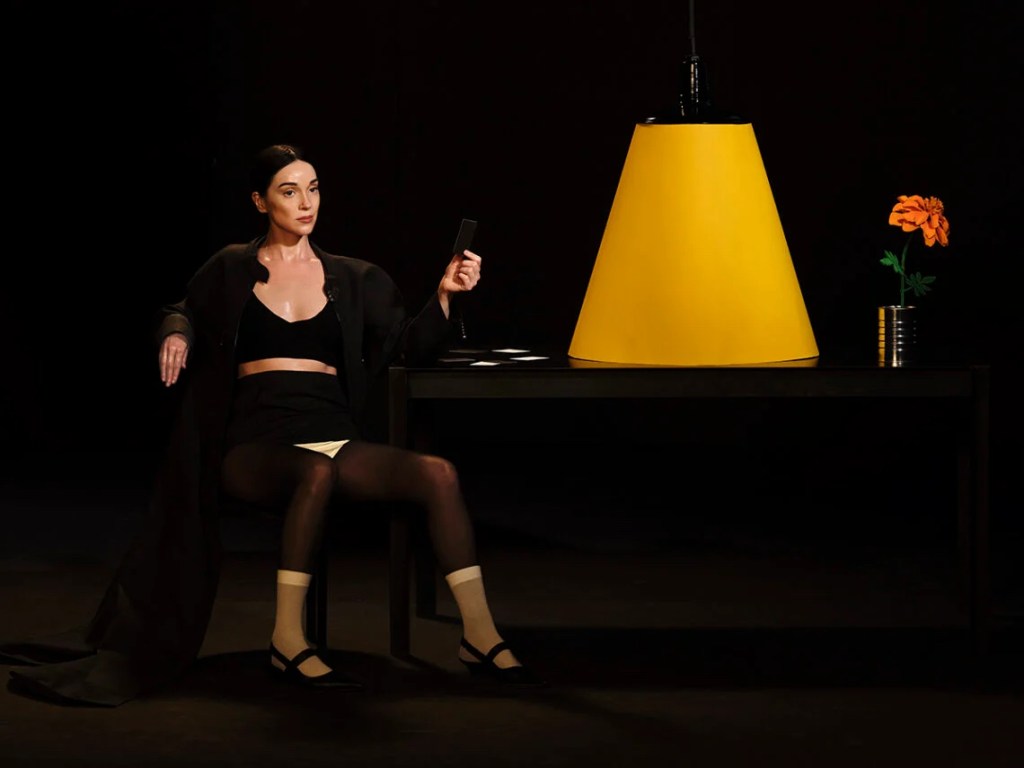
After my first listen-through, I felt some slight trepidation to replay, primarily due to St. Vincent’s romantic mourning of Sophie, an artist that Vincent has never worked with or met; that’s not the issue, as Vincent has done so many times (i.e. “New York” off Masseduction). Sometimes it works, like when we heard her sing about Marilyn Monroe on “Surgeon,” and more so because of the wider nuanced themes underlying it; “Sweetest Fruit” feels more of a half-thought-out song that lacks focus beyond its central theme of dreams. However, as I hit replay, it made me see how fantastic the music that surrounds it is. A shift back from her 80s pop-funk cosplaying nostalgia of Daddy’s Home, All Born Screaming sees St. Vincent working around comfortability with fluidity. She’s weaving elements of progressive rock/art rock, as a core, into this formidably bleak album that shifts conventions and like the production, travels and discovers new realms. It’s more tantalizing as this is St. Vincent’s first venture at constructing its production from head to programming, giving us something more spiritually inclined with her mind; unfortunately, some tepid moments keep it from existing as a perfect composition.
Daddy’s Home saw St. Vincent washing away the trauma of her childhood, specifically that from a father who saw himself getting into trouble with the government; however, I can understand how misplaced she was trying to elevate such to reflect that of who she was personifying with the costuming of Candy Darling. That isn’t to discredit one’s hardships, but it was almost like comparing apples and oranges—I took the music at face value and heard what Vincent was trying to say. It seems that getting some of it off her chest didn’t push out the emotional struggle that comes with defeat. All Born Screaming becomes a continuing reflection of it in tone, becoming more of a thesis on her ‘ships with people and lovers. The production is reminiscent of 90s hard rock, more so the rustic and grunge-influenced strings that amplify the audacity of the percussion. It makes the music feel more expansive. Though St. Vincent has co-produced her albums in the past, having this be her vision offers an interesting view of her artistry, like when she delivers a more tropical tint on “So Many Planets,” or the electronic touches on “Big Time Nothing,” before the funk kicks in.
Like much of her projects, the production is the focal key that ignites and allows the tangential flow of tracks to maneuver through the musty and bleak nature of the writing. Though that isn’t new territory for St. Vincent, it isn’t the most potent comparatively, with the writing, as its perspective is skewed to a smaller niche of humanity that is more personable to her. It isn’t St. Vincent weaving these intricate and satirical perspectives centered on experiences, and more so a breaking of a character that gives us something more to see. Her writing here is illustrious and continues to flow through her spirited storytelling. It makes tracks like “Hell Is Near,” “Big Time Nothing,” and “The Power’s Out” stand out so feverishly as opposed to “Flea” and “Sweetest Fruit,” the two tracks where the writing isn’t as potent. “Flea” is too simplistic and doesn’t have the energy to match its more rustic production. It’s a simple comparison track with little juice like “Sweetest Fruit.” Its tone deaf with the artistic admiration and poeticism of SOPHIE’s tragic end is a driving force, especially when focusing on the how. It doesn’t ring well and feels offputting.
The track that most stuck with me is “Violent Times.” It’s reminiscent of a classic Bond song with orchestral production elevating it past rock and painting a lavish picture of chaos. It’s like one of those theme songs from the 70s where the vocals eventually become the last hammer that puts the nail into the finishing project. It makes the rest of the album feel mildly lesser in comparison—the ingenuity is there, but they are more centralized to a genre realm. “Violent Times,” however, is anthemic and steers away from the norm, especially in the writing. Like “Los Ageless” and its more of a worldview perspective on its subject matter, “Violent Times” creates a story about searching for the lost amidst a scrupulous time in society. It makes “Flea” sound lesser in comparison. But outside of the two songs mentioned in the previous paragraph, the highs are exponential, which is 8 amazing tracks. There is a lot here to return to and I couldn’t recommend it any more, but with St. Vincent’s consistent streak of bangers, it shouldn’t come to a surprise I’m recommending here.
Though “Sweetest Fruit” causes trepidation about the authenticity of its delivery, there is a lot more here to go back to. I loved the production; it has consistency and doesn’t dwindle into forgetfulness, offering a palette of records that do enough to keep you hooked to the music. Though I consider it an upgrade to her last album, it still is far from perfect. I liked it a lot, just know I can’t be this harbinger for your ears. You’ll either vibe with the aesthetic or won’t, but I hope it’s the former. Give it a spin, and let me know how you feel in the comments below.


Leave a comment